
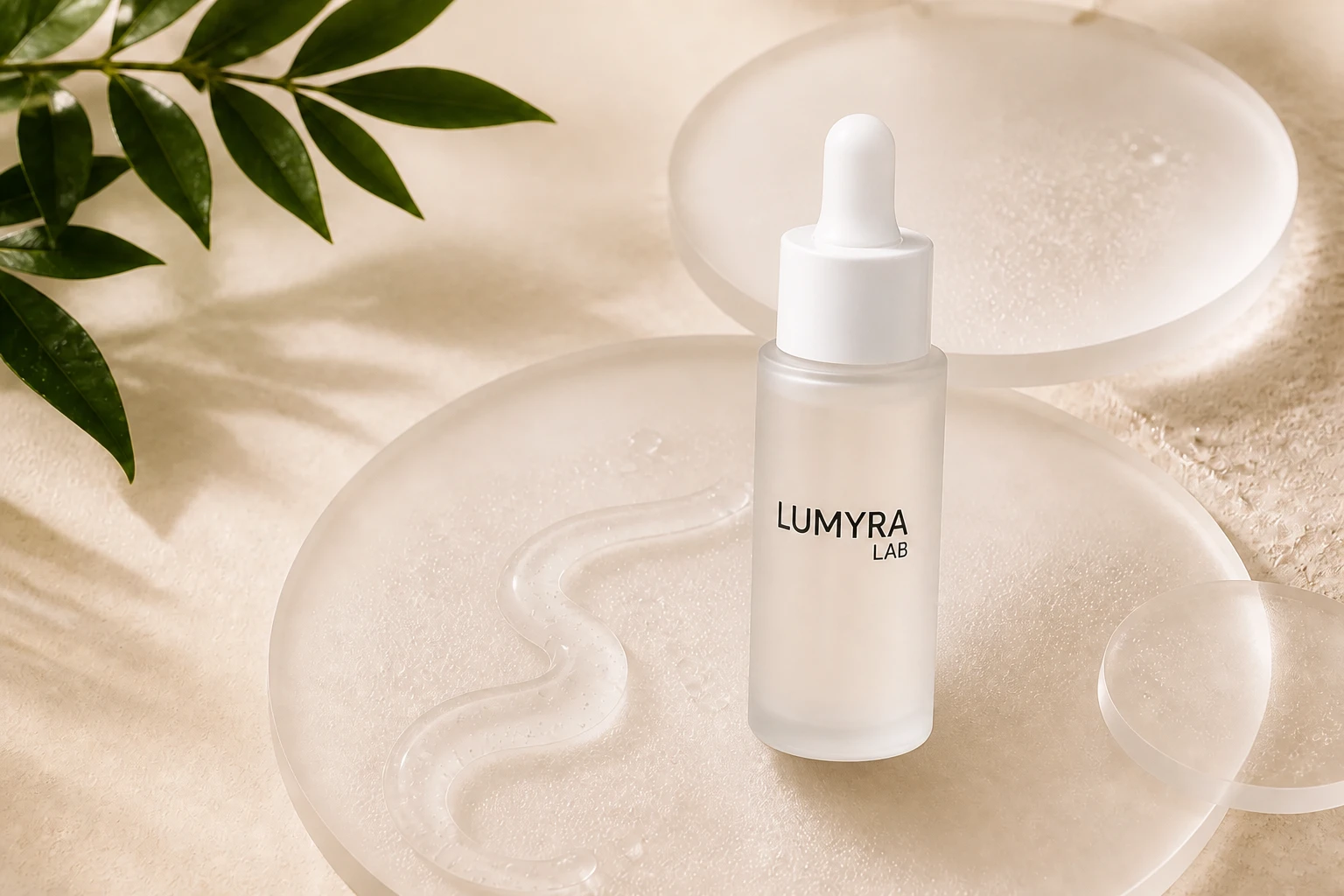
Most people who say exfoliation does not suit them have only ever tried the strong kind. Polyhydroxy acids are the same idea at a different speed, and they are the exfoliating component of 03.
The problem with the acids you already know
Glycolic acid is a small molecule. That is exactly why it works and exactly why it stings: it penetrates quickly and deeply, and skin that is dry, reactive or simply older often cannot take it more than occasionally.
Salicylic acid goes after oil rather than surface texture, which makes it a poor fit if congestion is not your issue.
What a PHA does differently
Gluconolactone and lactobionic acid are polyhydroxy acids. They loosen the bonds holding dull surface cells in place, the same job glycolic does, but their molecules are considerably larger, so they work at the surface and get there slowly.
Two things follow from that. The first is tolerance: the sting most people associate with acids largely does not happen. The second is that PHAs are humectants in their own right, so they hold water in the skin while they work rather than stripping it.
Mandelic acid sits alongside them in 03. It is technically an alpha hydroxy acid, the same family as glycolic, but it is the largest molecule in that family and behaves far more gently.
What to expect, and when
- Four to six weeks. Surface texture starts to feel smoother and makeup sits better.
- Eight to twelve weeks. Tone looks more even. This is where niacinamide and tranexamic acid in the same formula do their part.
- Anything faster than that is either a stronger acid than you were told, or a claim rather than a result.
Building it in
Start with two nights a week and go up from there if your skin is comfortable. 03 is an evening step. On the nights you use 06 Retinol, it replaces 03 rather than joining it: both are working on the same surface, and using them together is not a stronger routine, it is two exfoliants on one barrier.
03 Glow Serum publishes its full ingredient list, with the share of each one, on its product page.